
The food of the poor that became a delicacy: how oysters achieved success and why they are so loved
- Back to the past
- Are oysters food for the poor?
- A turning point: how oysters became a luxury again
- The secret to popularity
- How to eat oysters properly in a restaurant
- Facts about oysters that will surprise you
Today, oysters are a symbol of gastronomic luxury and a must-have item on the menu of all prestigious restaurants. They are served on an ice bed, with a slice of lemon and a glass of white wine. But this was not always the case. The journey of the oyster from cheap food for the poor to a delicacy is a story full of unexpected twists and turns. In this article, we will tell you how the oyster made its way from the mud to the princes and who first decided to try it.
Back to the past
It is difficult to name the specific person who came up with the idea of eating oysters. It happened thousands of years ago, back in the Stone Age. Archaeologists find giant dumps of oyster shells all over the world — from the coast of Europe to Japan and North America.
For ancient people, oysters were the perfect food. They didn't need to be tracked down or hunted for long — they just lay on the shore, attached to the rocks. And unlike mushrooms or berries, they couldn't poison you.
The ancient Romans elevated the consumption of oysters to a cult. They didn't just eat them, they learned how to breed them. For example, the merchant Sergius Orata in the 1st century BC became famous for creating the first oyster farms in artificial reservoirs in history.
The Romans valued oysters for their unusual taste and considered them an aphrodisiac. Oysters were delivered to Rome from the most remote corners of the Empire, frozen in snow or preserved in special brines. It was one of the world's first delicacies, available only to the elite.
Are oysters food for the poor?
After the fall of the Roman Empire, oysters lost their status for a long time. In the Middle Ages and up until the 19th century, they were considered food for the poor in Europe and America. There are several reasons for this:
— Incredible abundance. Oyster beds were huge. For example, at the mouth of the Thames and off the coast of the Netherlands, their stocks seemed inexhaustible.
— Cheapness. Oysters were so cheap that even the poorest sections of the population could afford them. In England and France, they were eaten like chips are today — just like that, on the go.
— Food for workers. They were consumed in huge quantities by workers and builders, as they were a filling and affordable source of protein. Historians believe that oysters were fed to the workers who built the famous cathedrals and infrastructure of London and New York.
In Victorian England, oyster kiosks lined the streets of industrial cities. They were sold by the dozen, like fast food. After the meal, the shells were simply thrown on the ground.
A turning point: how oysters became a luxury again
With the development of industry, waste flooded into rivers and seas. Oysters, as natural filters, passed all the dirt through themselves, which made them dangerous to health. Major epidemics of typhoid and cholera in the 19th century were often linked to the consumption of contaminated oysters.
In addition, oyster beds, which had seemed inexhaustible for centuries, began to be depleted. By the end of the 19th century, the population of wild oysters in Europe and America had declined significantly.
Suddenly, oysters went from being a widely available product to a delicacy. Their prices skyrocketed, and now only wealthy people could afford them. However, the crisis gave impetus to the development of modern oyster aquaculture. Technologies for the artificial breeding of mollusks in controlled clean waters appeared. Thus, the oyster came full circle, returning to the tables of the aristocracy, but under new conditions.
The secret to popularity
Why oysters, and not some other shellfish, have become a cult dish:
— Complex flavor profile. The taste of oysters is not just “fishy.” It is a complex cocktail of different flavors that varies depending on the species and habitat. You can taste sweet, nutty, coppery, metallic, or even cucumber notes. The taste of an oyster from Normandy will be radically different from that of an oyster from South Korea.
— Texture. Delicate, firm, sometimes creamy, sometimes crunchy, but always unique.
— Umami. This is the fifth basic taste (along with sweet, sour, salty, and bitter) — deep, rich, leaving a long aftertaste and a feeling of “coating” on the tongue. Oysters are rich in glutamates, which cause umami.
How to eat oysters properly in a restaurant
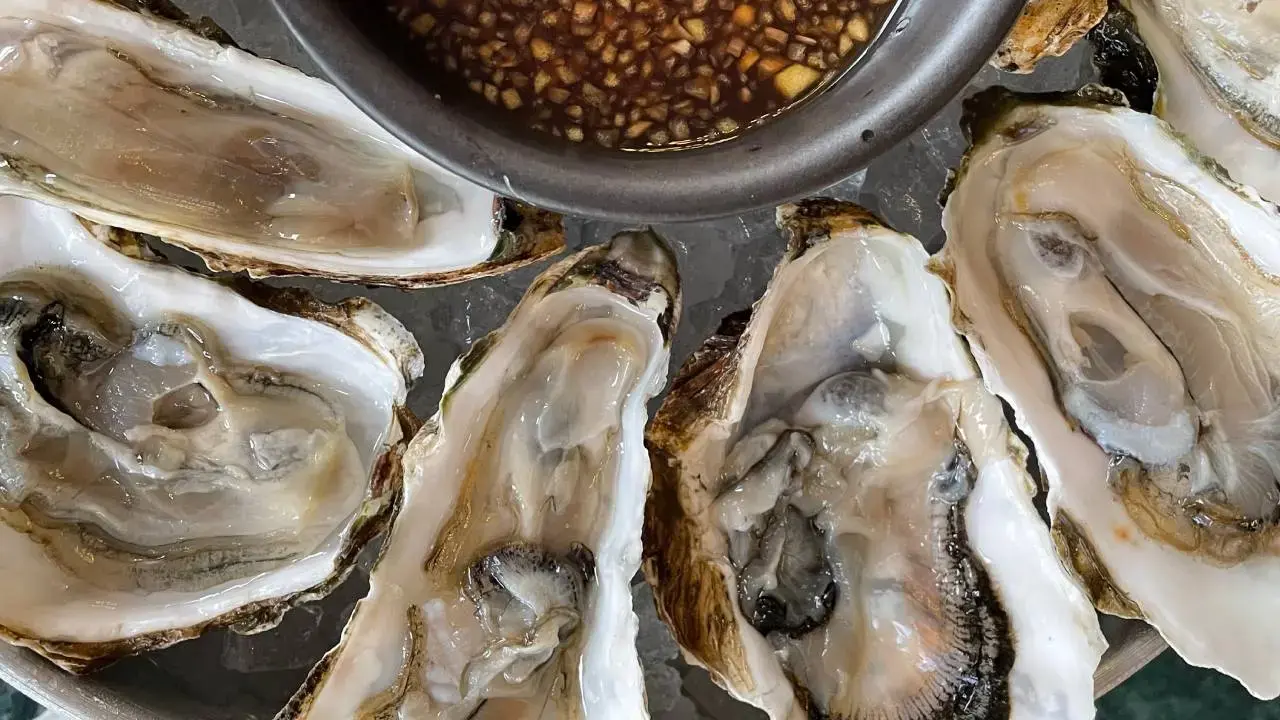
Oysters are always served alive on a large platter with ice. The shell should be tightly closed or close immediately when touched. This is the main sign of freshness.
Classic accompaniments for oysters are a slice of lemon, mignon sauce (vinegar sauce with shallots and pepper), grated horseradish, and pieces of rye bread. Some people prefer to eat oysters without anything else to enjoy their pure flavor.
How to eat oysters in a restaurant:
— Take an oyster in your hand (with a special fork or just your fingers). Drizzle a few drops of lemon juice or sauce on it.
— Bring the narrow edge of the shell to your mouth and silently suck out the contents. You can use a special small fork to help you, but the classic way is to “suck” it out.
The ideal drink to accompany oysters is a dry, acidic white wine, such as Chablis, Muscadet, or champagne. The acidity and minerality of the wine perfectly complement the taste of the oyster.
It is impossible to give a definitive answer to the question of which oysters are the most delicious — it is a matter of preference. Among those most appreciated by gourmets are New Zealand Bluff Oysters, Hasansky, Irish Tia Maara, as well as French Fin de Claire and Marennes Oléron.
Facts about oysters that will surprise you
— They form ecosystems. Oyster reefs are “underwater cities” that are home to dozens of species of fish and crabs, and also serve as natural breakwaters that protect the coastline.
— Oysters are natural ocean purifiers. They filter up to 200 liters of water per day, separating plankton and impurities. That is why it is so important that oysters are grown in clean waters.
— An old fishing rule says that oysters should only be eaten in months with the letter “r” in their name (September through April). This is due to their breeding season in the summer (May through August), when the mollusks become milky, less tasty, and catching them harms the population. With the development of aquaculture, the rule has become less relevant, but many gourmets still adhere to it.
Looking for a place to try high-quality seafood? Come to any Lambic restaurant! We will be sure to recommend a good beer or wine to go with it — our drinks menu features labels from all over the world. See you soon!


Lager Instead of Coffee: Can You Pair Beer with Breakfast and Light Meals?
Contents Can you drink beer in the morning and during the day Which salads pair well with beer Which breakfasts go well with beer It's commonly believed that beer is an evening drink, while breakfast or brunch usually comes with juice, coffee, or sparkling wine. In fact, pairing beer with morning and daytime dishes is a perfectly normal practice. The variety of styles makes it possible to find a match for almost any dish. And when chosen correctly, beer can work like an aperitif, awakening the appetite and gently aiding digestion. Can you drink beer in the morning and during the day Yes, and there are several reasons why. First, an ordinary lager or ale isn't any stronger than champagne, so even a glass of beer won't really get you drunk. Besides, hop bitterness in small doses stimulates gastric juice production, helping food digest better. The main thing is not to overdo the dose and not to pair the drink with greasy fast food. Which salads pair well with beer The main pairing principle is either contrast (something sour balancing something fatty) or harmony (malty sweetness softening salty and spicy flavors). Here are a few examples: — Salads with meat and poultry. Olivier salad with smoked duck pairs best with a light lager: its bready bitterness cleanses the palate. A salad with beef, pumpkin, and mustard dressing calls for a Belgian dubbel – its caramel sweetness will soften the spiciness.— Salads with fish and seafood. Niçoise salad with tuna and anchovies goes perfectly with a pilsner. A salad with shrimp, avocado, and feta cream is best served with a wheat beer (weissbier) – its soft banana and spicy notes will highlight the flavor.— Classic salads. Caesar salad pairs well with a wheat ale: banana and spicy notes will bring out the cheese and dressing. For Caesar salad with shrimp, a seasonal beer works well – its spicy acidity complements the seafood. Which breakfasts go well with beer An excellent beer pairing can be found for almost any popular breakfast dish: — Waffles. A potato waffle with salmon and poached egg pairs well with a sour ale. A waffle with chicken and mushrooms goes with a dry gose. Zucchini waffles with wasabi shrimp pair with a witbier.— Bruschetta. With beef and caramelized onion – pair with an amber lager. With chicken liver and arugula – pair with a milk stout.— Bacon and eggs. The best match is a light lager, which refreshes and cleanses the palate.— Sweet breakfasts. French toast with berries or oatmeal with raspberries pair wonderfully with a fruit lambic. Experiment – and you'll be amazed how many new nuances open up in familiar food. Or better yet, come for breakfast or a business lunch at Lambic: we'll recommend a beer that will win your heart, and tell you which dishes go best with it. See you soon!
17 June 2026
Beer and Cheese: A Pairing You Might Not Have Known About
Contents Why cheese and beer is a classic European pairing Which beer styles suit soft, semi-hard, and aged cheeses What to drink with blue cheese, goat cheese, and camembert Cheese and beer: ready-made set ideas for an evening at home and at Lambic restaurant Wine with cheese is a classic. But few people know that cheeses of various kinds can also be paired with beer. Beer doesn't overpower the flavor of cheese — it enhances it. Thanks to the wide variety of styles, you can find a match for everything from delicate mozzarella to pungent gorgonzola. Let's look at which cheese works best with beer and suggest a few interesting pairings. Why cheese and beer is a classic European pairing In Belgium, Germany, and the Netherlands, cheese boards have been served with beer for centuries. The reasons are simple: — carbon dioxide bubbles cleanse the palate of the cheese's richness;— hop bitterness helps balance it;— malty sweetness and fruity esters bring out even the most aged cheeses. Which beer styles suit soft, semi-hard, and aged cheeses Soft cheeses (brie, camembert, mozzarella, burrata) call for gentle styles: weissbier, witbier, bock. They add fruitiness without overwhelming the creaminess.Semi-hard cheeses (gouda, edam, tilsiter, cheddar) pair well with malty lagers, amber ales, and dubbels.Aged and hard cheeses (parmesan, gruyère, mature cheddar) go with IPA, tripel, barley wine, or imperial stout. What to drink with blue cheese, goat cheese, and camembert Blue cheeses (gorgonzola, roquefort, dorblu) pair perfectly with sour beer: fruit lambic or gose. A classic combination is roquefort with raspberry lambic.Goat cheese, with its tangy, earthy character, goes well with witbier, saison, or dry lager.Camembert and brie are best served with milk stout or porter: coffee-chocolate notes harmonize with the creaminess. Cheese and beer: ready-made set ideas for an evening at home and at Lambic restaurant Here are a few tried-and-tested combinations: Light aperitif set:— mozzarella or burrata with a Belgian witbier (such as Hoegaarden);— fresh goat cheese with a seasonal beer. Rich set:— aged gouda with an amber lager (märzen);— cheddar with a medium-bitterness IPA. Experimental set:— gorgonzola with lambic (cherry or raspberry);— camembert with milk stout. A versatile option for home: take four cheeses – brie, gruyère, roquefort, and fresh goat cheese – and serve them with witbier, tripel (such as Tripel Karmeliet), kriek, and gose. Try each pairing, and you'll be amazed how differently both the beer and the cheese reveal themselves. At Lambic, we'll offer you cheese appetizers to match any beer you choose. Come by – we'll find something to surprise you with!
17 June 2026